Case Study 6 :FREE AND INFORMED CONSENT
Challenges
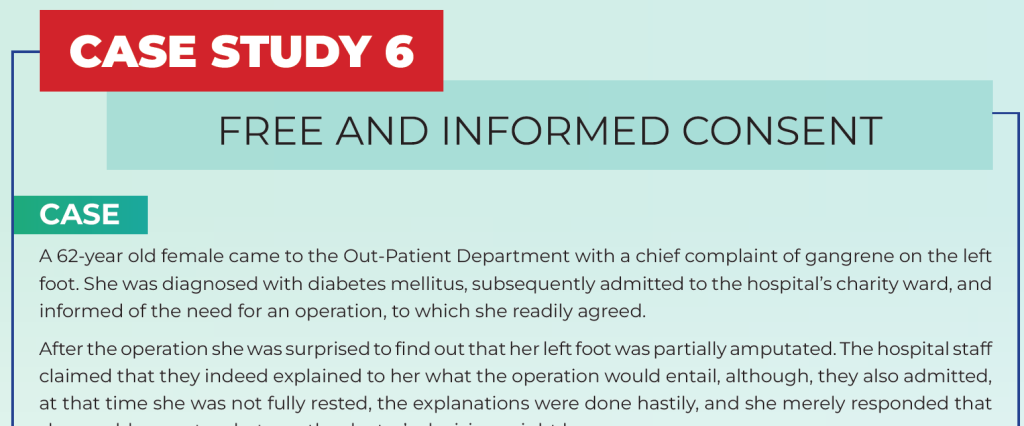
A 62-year old female came to the Out-Patient Department with a chief complaint of gangrene on the left foot. She was diagnosed with diabetes mellitus, subsequently admitted to the hospital’s charity ward, and informed of the need for an operation, to which she readily agreed. After the operation she was surprised to find out that her left foot was partially amputated. The hospital staff claimed that they indeed explained to her what the operation would entail, although, they also admitted, at that time she was not fully rested, the explanations were done hastily, and she merely responded that she would agree to whatever the doctor’s decision might be.
Question
What should one keep in mind when explaining procedures to patients?
Solutions
Given that each person holds the responsibility to take care of one’s own health, procedures should be administered only with the free and informed consent of the patient (or if incompetent, of the patient’s proxy, in accord with the patient’s known and reasonable wishes).
In this respect health care professionals must supply the patient with the medical information necessary for the patient to make an informed decision. Such information includes the procedure’s purpose, anticipated risks and benefits, alternative procedures, and hoped-for results.
Health care professionals should also ensure that the patient understands the information given. Such comprehension varies according to the patient’s capacity (education, mental and emotional state, etc.). The patient should also exercise freedom in making decision – aside from having sufficient knowledge of the situation, there should be no undue influence from the relatives, health care professionals (at times with the excuse that doctors know best), or other parties (insurance company, employer, etc.).