
In the 1980s, a diagnosis of HIV (human immunodeficiency virus) meant sure and imminent death. With no known treatment available, it was only a matter of time before HIV progressed into AIDS (acquired immunodeficiency syndrome), leaving you with weeks, maybe months, to live.
Thanks to antiretroviral therapy (ART), a combination of drugs taken daily to suppress production of the virus, HIV cases have dropped significantly worldwide. In 2023, a reported 1.3 million individuals globally were diagnosed with HIV—that’s 39% less than cases in 2010 and 60% less than cases in 1995, when HIV was at its peak, says hiv.gov.
Yet for all the medical breakthroughs and awareness campaigns to prevent the onset and spread of HIV and AIDS, the infection persists. The Philippines has been named by the Joint United Nations Programme on HIV/AIDS (UNAIDS) as the country with the fastest growing immunodeficiency virus epidemic in the Asia-Pacific region. An estimated 57 Filipinos are diagnosed with HIV daily, said UNAIDS, and cases are up by a staggering 550%—from 4,400 in 2010 to 29,600 in 2024.
According to the World Health Organization, about 252,800 Filipinos are living with HIV in 2025; a third of the newly diagnosed cases are individuals between the ages of 15 to 24 years.
Despite the alarming numbers, Marion Priscilla A. Kwek, MD, an Infectious Diseases Specialist at Makati Medical Center (MakatiMed), is doing her part to help achieve UNAIDS’ 95-95-95 target for HIV: By 2030, 95% of people with HIV should be aware of their status, 95% of those who know their status are on antiretroviral therapy, and 95% of those on ART would have achieved viral suppression.
“That’s why we always advocate for education,” she says. “The shift now is early diagnosis and early treatment. Previously, with the older antiretroviral drugs, you have to wait for a certain immune level before you start giving a patient the medicine. Meanwhile, the virus is replicating in the body and the illness is progressing, and you can have other infections come in before you start giving your ART.
“If you are diagnosed early enough, on the day that you are tested, you can start on ART or antiretroviral therapy.”
Understanding HIV and AIDS
Human immunodeficiency virus, or HIV, is a virus that weakens the immune system, making you vulnerable to life-threatening illnesses. The most common route of transmission is unprotected sexual contact, whether it is with a male-to-female or male-to-male partner. Other ways the virus is transmitted are by sharing needles and syringes with an individual who is HIV-positive, and for HIV-positive women, from mother to child in utero (or in the womb) and through breastfeeding.
“You cannot acquire it from casual contact, hugging, kissing, and shaking hands,” says Dr. Kwek. “It is very important that we emphasize this because a lot of people with HIV face stigma, and even some people are hesitant to touch them. If you have a relative or friend who has HIV, feel free to hug them because they need it.”
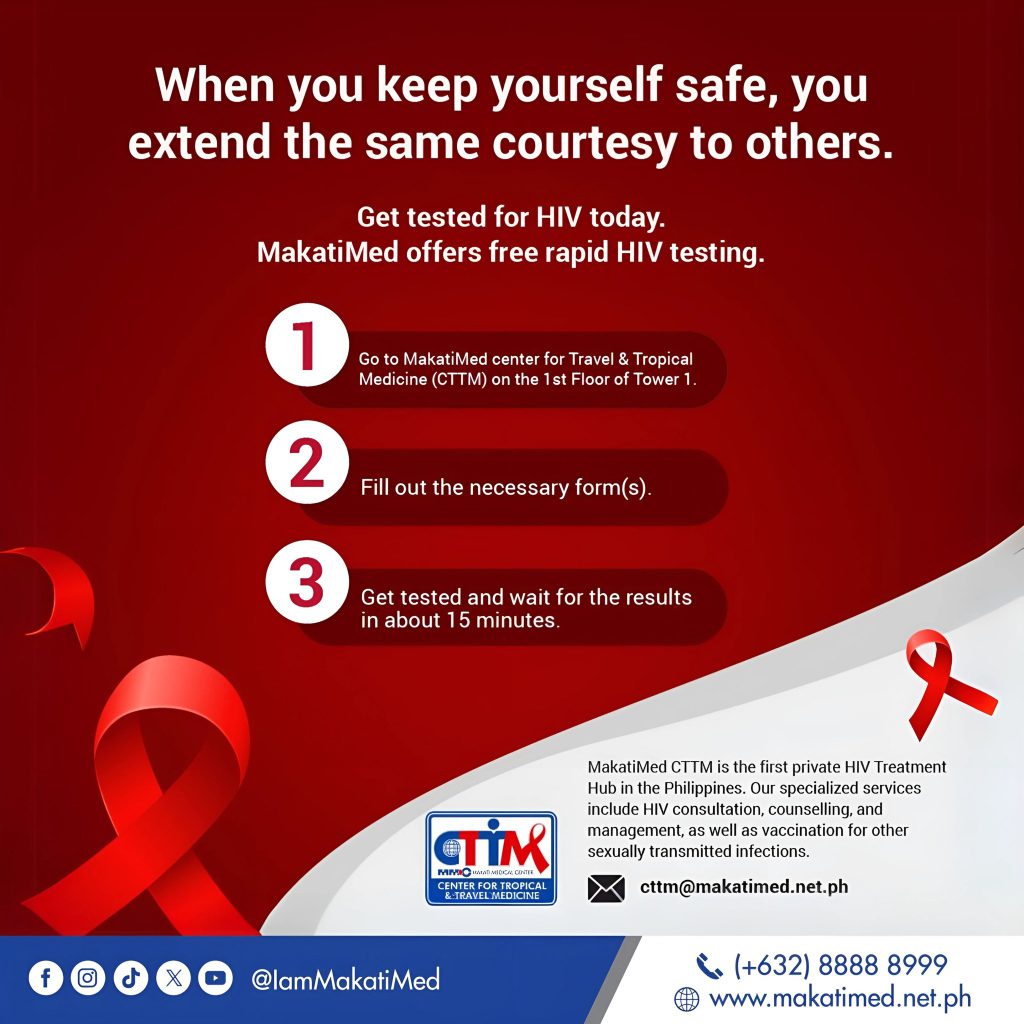
Like hypertension, which has no obvious symptoms until you take your blood pressure, you can remain asymptomatic of HIV for many years, and only know you have it when you get tested. HIV self-test kits, which require a small sample of your blood, are available in physical and online stores. You can also get them for free from the Department of Health in collaboration with HIV primary care centers nationwide.
A positive HIV test result means you can begin treatment with ART. This group of drugs stops the production of HIV, reducing the amount of the virus circulating in your blood. “When people with HIV are on treatment and they are virally suppressed, then they are no longer infective enough to pass on the virus to others,” she says.
While not a cure, ART prevents HIV from progressing to AIDS. Acquired immunodeficiency syndrome is the advanced stage of HIV.
“Not everybody with HIV will progress to AIDS because with timely treatment, people who have the virus can have no immune deficiency for as long as they are maintained on the proper treatment,” she says.
Barriers to care: Denial and self-stigma
Still, it does not make sense. Why does HIV remain at epidemic levels in the Philippines, where self-test kits and ART are accessible?
“There is denial, which is common. Some do not come back anymore or opt to get tested again in another facility,” says Dr. Kwek. “For others, expense could be an issue, but we can always refer them to places where they can access the services for free.”
Mental health issues have also impacted patients. Some self-stigmatize, or beat themselves up for their diagnosis, while others anticipate judgement when they go for a consultation.
“I have a few patients who were already on treatment, and then for whatever reason—maybe a loss of a job, loss of a partner, loss of a parent, or financial issue—they suddenly stop coming back,” says Dr. Kwek. “And when they do come back, the disease has progressed. It is more challenging to treat someone who has had treatment and stopped, versus someone who’s never had treatment before, because there is the issue of drug resistance. It is a virus, so it can mutate.”
Preventing HIV: PrEP and safe practices
Ultimately, preventing the spread of HIV requires mindfulness, compliance, and help from those who care about you. If you have the virus, taking ART as prescribed by your healthcare provider and practicing safe sex by using a condom means you are doing your share in protecting others from acquiring this lifelong condition.
If you are at risk of contracting HIV, ask your doctor about Pre-Exposure Prophylaxis (PrEP). Available as an oral medication and injectable, PrEP reduces your chances of getting HIV through sexual contact by an impressive 99% and contracting the virus through shared needles by at least 74%.
Dr. Kwek observes that the presence of family members and friends during a patient’s consultation “does wonders. The burden is shared, the patient does not feel like ‘It is me against them.’”
Choosing to work with a doctor who only wants to see you live a long and productive life—because, yes, it is possible—gives you hope and something to look forward to despite your diagnosis.
“I’m an infectious disease practitioner and [HIV] is like any other infection,” says Dr. Kwek. “You just happened to get exposed and acquired it. But this is not a punishment. This is a virus. It is an infection that is manageable and can be controlled.”
Indeed, HIV does not have to be the death sentence that it was 40 years ago. “I find that it is actually easier to manage than diabetes,” adds Dr. Kwek with a chuckle. “If you are taking your meds regularly, then you are guaranteed a good outcome.”
Article based on “Healthline with Makati Med hosted by Nicole Jacinto” guesting of Dr. Marion Priscilla A. Kwek, MD, last December 02, 2024.
Got questions/concerns? Reach us via MakatiMed On-Call at (+632) 8888 8999 or at [email protected].
Follow our social media pages for more health-related content and for the latest updates: https://www.makatimed.net.ph/social-media-pages/