Bioethics Bits
“Bioethics Bits” offers a concise and practical guide to navigating the complex ethical dilemmas encountered in healthcare. Using the IDEA framework—a four-step tool for ethical decision-making—we provide a clear process for identifying facts, determining dilemmas, exploring options, and acting on a decision. This resource is designed to empower healthcare professionals, patients, and families with the knowledge needed to make sound, justifiable choices in challenging situations.
CASE STUDY

Case 11 : DNR AND NO CPR
Case Study 8 : PERSONALIZING HEALTH CARE Challenges A 45 year old male lay in a comatose state, attached to a respirator for the past
Case 10 : ORDINARY AND EXTRAORDINARY MEANS
Case Study 8 : PERSONALIZING HEALTH CARE Challenges A 15-year old male is admitted with the chief complaint of pain associated with liver cancer. The
Case 9 : WELL-FORMED CONSCIENCE
Case Study 8 : WELL-FORMED CONSCIENCE Challenges A health care professional harbors doubts regarding the moral acceptability of some procedures he cooperates in at the
Case 8 : PERSONALIZING HEALTH CARE
Case Study 8 : PERSONALIZING HEALTH CARE Challenges A health care professional working at a hospital notices a colleague frequently treats their patients in an
Case 7 : TRUTH TELLING TO THE DYING
Case Study 6 :FREE AND INFORMED CONSENT Challenges A 62-year old female came to the Out-Patient Department with a chief complaint of gangrene on the
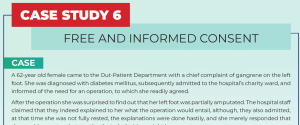
Case 6: FREE AND INFORMED CONSENT
Case Study 6 :FREE AND INFORMED CONSENT Challenges A 62-year old female came to the Out-Patient Department with a chief complaint of gangrene on the

Ethical Decision-Making Tool
The Makati Medical Center Bioethics Educational Committee has adopted an Ethical Decision-Making Framework to assist healthcare professionals, patients, families, and institutions in navigating situations where values, principles, and responsibilities may be in conflict. Ethical challenges in clinical practice often involve balancing patient autonomy, medical best practices, cultural and spiritual beliefs, institutional policies, and societal considerations. This framework, summarized by the acronym “IDEA” (Identify, Determine, Explore, Act), provides a clear and systematic approach for addressing such dilemmas. By encouraging the collection of all relevant facts, recognizing the ethical principles at stake, exploring a range of options, and acting on well-justified decisions, the tool helps ensure that decision-making is both morally sound and practically effective. It is designed not only as a guide for individual cases but also as an educational resource to strengthen ethical awareness and promote collaborative discussions across healthcare teams.